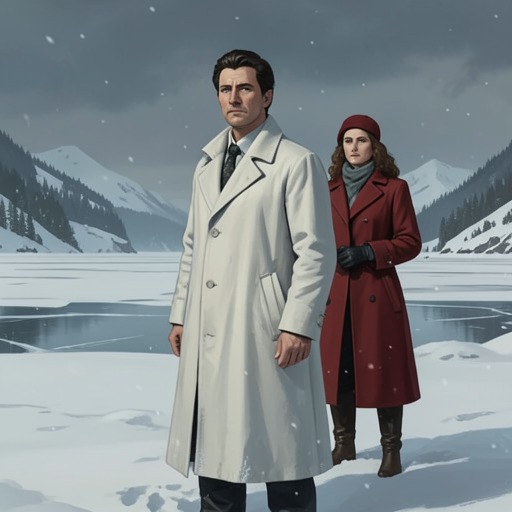
Ice as a preserver of the past
Blind Willow, Sleeping WomanIce as a preserver of the past is the central principle of the Ice Man’s unusual knowledge and the governing image of his wife’s growing isolation. Ice makes everything it contains distinct and enduring, but it holds no future. The same power that lets the Ice Man see other people’s histories also describes the danger of the life he and his wife build together: a life in which the past accumulates until escape seems impossible.
Ice and the Knowledge of the Past
The Ice Man explains his knowledge not as mind-reading but as a way of looking deeply into a person, as though that person were inside a clear block of ice. He can see the wife’s family, age, interests, health, school, and friends, including things she herself has forgotten. The image makes ice a medium of preservation and legibility: what has happened remains sealed within it, cleanly and distinctly available to view.
That ability has a firm limit. Asked whether he can see the future, the Ice Man says he is not interested in it and has no concept of it. “Ice contains no future, just the past, sealed away.” His account presents ice not simply as cold or as a supernatural power, but as a way of holding experience outside the movement of time. It preserves what exists already; it cannot disclose what is coming.
The wife is relieved that he cannot tell her future. Yet the limit also defines the difference between them. She can imagine what may happen and fear it, while he inhabits a world of preserved pasts. The story makes this difference intimate before it makes it threatening: his knowledge draws her toward him, but the logic of that knowledge will later shape the terms of their shared life.
A Man Without His Own Past
The Ice Man can know the past of others while having no accessible past of his own. After they return to Tokyo, he and the wife meet often, spending weekends together on park benches and talking rather than following the familiar pattern of movies, cafés, or restaurant meals. He speaks about many subjects but not about himself. When she asks where he was born, what his parents were like, and how he became an Ice Man, he says he does not know. He cannot say whether he had parents or an age, or where he began.
This absence complicates his role as the keeper of memory. The Ice Man preserves other lives but cannot place himself within a history of his own. The story compares his loneliness to that of an iceberg floating in darkness: the figure associated with clear, intact memory is personally cut off from origins and human connection. He loves the wife as she is in the present, apart from her past or future, and she loves him as he is now. Their attachment offers a possible refuge from the limits of history, but it is founded on a present that cannot supply the ordinary background of shared human identity.
When the couple discuss marriage, the wife has just turned twenty and has never before truly loved anyone. Her mother and older sister oppose the match because they do not know the Ice Man’s origins, and question how a person made of ice can meet a husband’s responsibilities. Their objections frame the couple’s intimacy against the practical demands of family life. The Ice Man’s lack of a past, at first part of his mystery, becomes a real obstacle to belonging and a sign of how little can be known about the future they might share.
The South Pole and the Closing Future
The South Pole intensifies the story’s association between ice and a future that has disappeared. After the wife raises the idea of traveling there, she feels the Ice Man change: his gaze grows more piercing, frost spreads over his fingers, and he becomes quieter and stops eating. Five days before they are due to leave, she proposes going somewhere warmer instead, suggesting Europe or Spain. He refuses, saying he has already bought the tickets and her cold-weather clothes, and that they cannot back out.
The wife’s repeated dream gives this decision a form she cannot dismiss. In it, she falls into a deep hole, freezes, and remains conscious but unable to move. As time passes, she feels herself becoming part of the past, with no future ahead; others watch her slip away. The dream turns the Ice Man’s theory into a feared personal fate: preservation is no longer the clear containment of someone else’s history but a condition in which her own life is being sealed off from change.
When she wakes, she finds the Ice Man beside her and cries. He tells her the dream came from the past, not the future, and says that dreams should not control her. His explanation restates his faith in the past as the only material ice can contain, but it does not reassure her. She agrees without being certain. The gap between his calm account and her continuing doubt keeps the dream from resolving into a simple prediction or a mere reassurance.
Once they reach the South Pole, winter closes off travel. Three months after their arrival, the wife learns that she is pregnant and believes her child will be a tiny Ice Man. She imagines the child inheriting the father’s icicle eyes and frost-covered fingers, and understands the family’s future as a continuation of the frozen condition around them. She feels that they will never leave the South Pole: the weight of the eternal past has taken hold and will not release them.
Preservation as Isolation
The story’s final image makes preservation at once an expression of love and a sign of emotional loss. The wife says that the warmth she once knew has retreated so far that she sometimes forgets it existed. She remains able to cry, and the Ice Man kisses her cheeks and takes the frozen tears onto his tongue. He tells her he loves her; she knows that he does. But his words are carried farther into the past, while her tears continue in their isolated home at the South Pole.
Ice, then, does not merely protect the past from disappearance. In the story, its preservation can also prevent life from moving onward. The Ice Man’s gift is to retain every detail, yet he cannot offer a future; his own missing origins foreshadow the absence of a secure shared history, and the South Pole makes that absence into a physical enclosure. The wife’s pregnancy appears to promise a new beginning, but she experiences it instead as the extension of the Ice Man’s frozen world. The governing image ends in contradiction: love remains real, but it cannot restore warmth or loosen the past’s hold.